
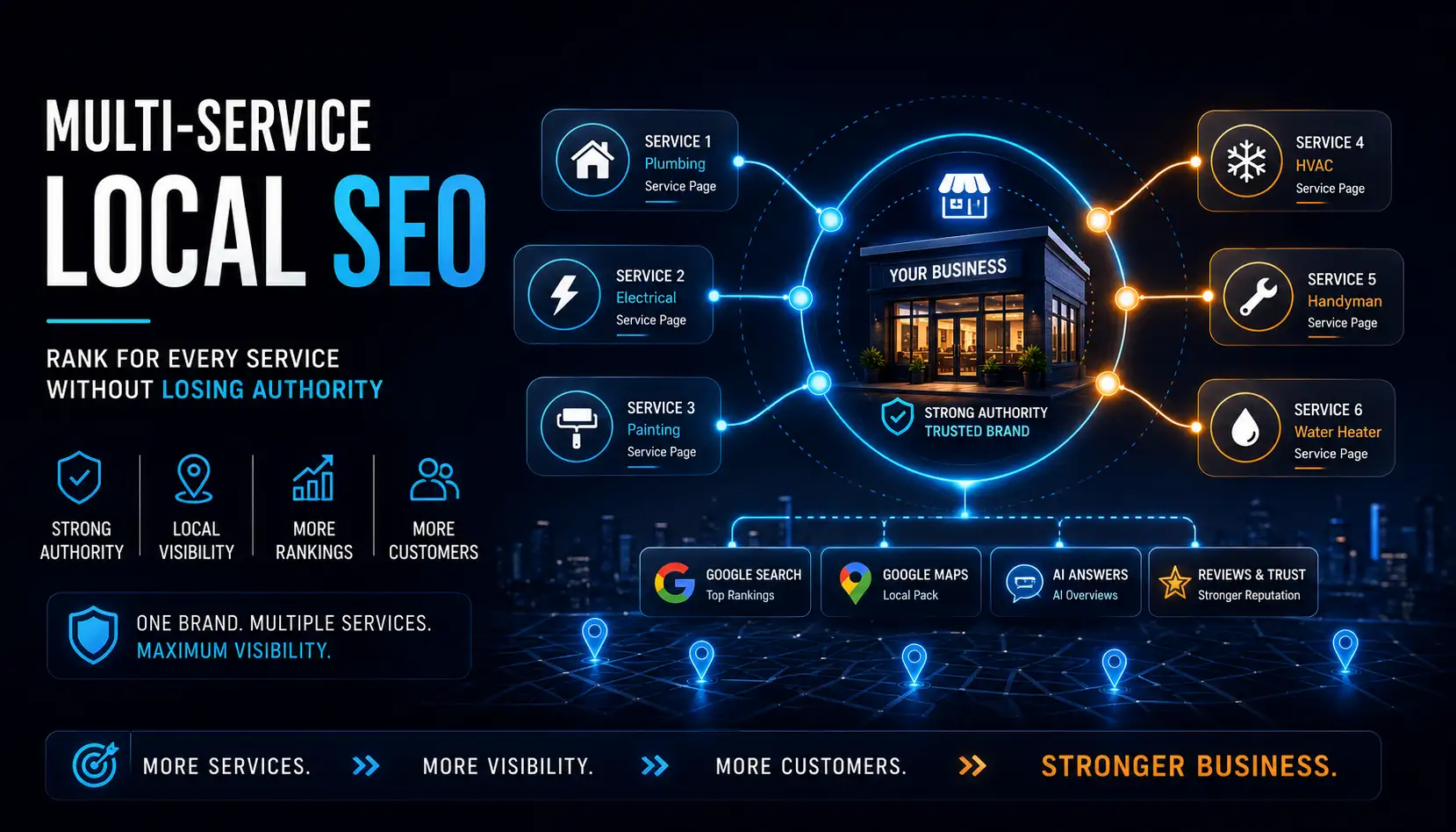
Businesses offering multiple services face a complex local SEO architecture challenge. Learn how to build a multi-service SEO strategy that ranks for all your core offerings without splitting your authority or confusing search engines.
Many local businesses offer more than one service a plumber who also does HVAC, a law firm that handles both personal injury and estate planning, a gym that offers personal training, nutrition counseling, and group fitness classes. For these multi-service businesses, local SEO strategy requires a more sophisticated architecture than single-service businesses need. Handled poorly, multi-service SEO dilutes your authority and confuses search engines. Handled well, it creates a portfolio of specific, highly converting ranking positions across multiple revenue-generating categories.
The foundational principle of multi-service SEO is dedicated content for each service. Your homepage cannot rank competitively for five different services simultaneously it lacks the depth, specificity, and keyword focus that each service deserves. Instead, create individual service pages for each primary offering. Each page should be treated as a standalone local SEO asset: unique content of 500 words or more, a specific title tag and meta description for that service, locally specific keyword integration, service-specific FAQs, and relevant calls to action.
Your Google Business Profile primary category should reflect your core, most valuable service. Use secondary categories for your additional services. This ensures your GBP appears for your most important search queries while remaining eligible for secondary service searches. Do not add categories for services you don’t actively offer over-categorization can trigger GBP policy issues and dilute your relevance signals.
Internal linking between your service pages and your homepage creates a clear site architecture that helps search engines understand the relationships between your services and distributes authority efficiently across your site. Your homepage should link to each service page in the primary navigation. Related service pages should cross-link where the services are genuinely complementary.
Content marketing for multi-service businesses can efficiently serve multiple service goals simultaneously. A home services company might publish a seasonal maintenance guide that addresses HVAC, plumbing, and electrical topics serving all three service categories with a single comprehensive piece. The key is ensuring each mentioned service has its own linked dedicated page for searchers who want more information about a specific service.
Frequently Asked Questions
Q: Should I create separate websites for each of my services?
A: In almost all cases, no. Separate websites split your domain authority without a proportional SEO benefit. A single domain with well-structured service pages and strong internal linking architecture consistently outperforms multiple thin single-service sites. The exceptions are services that are genuinely distinct businesses with different branding, geographic markets, and customer bases.
Q: How do I avoid keyword cannibalization when multiple service pages target similar local terms?
A: Differentiate each service page’s primary keyword target clearly. A plumbing company’s “emergency plumber” page should target emergency-specific modifiers; the “water heater installation” page should target installation-specific terms; the “drain cleaning” page should target maintenance terms. Clear keyword differentiation prevents pages from competing against each other in rankings.
Q: How do I decide which of my services to prioritize in my local SEO strategy?
A: Prioritize by revenue contribution and margin the services that generate the most profitable revenue deserve the most SEO investment. Supplement this with competitive opportunity analysis in some categories, dominant players make first-page ranking extremely difficult, while adjacent categories may be less contested. Balance revenue priority with ranking achievability for the most efficient resource allocation.