
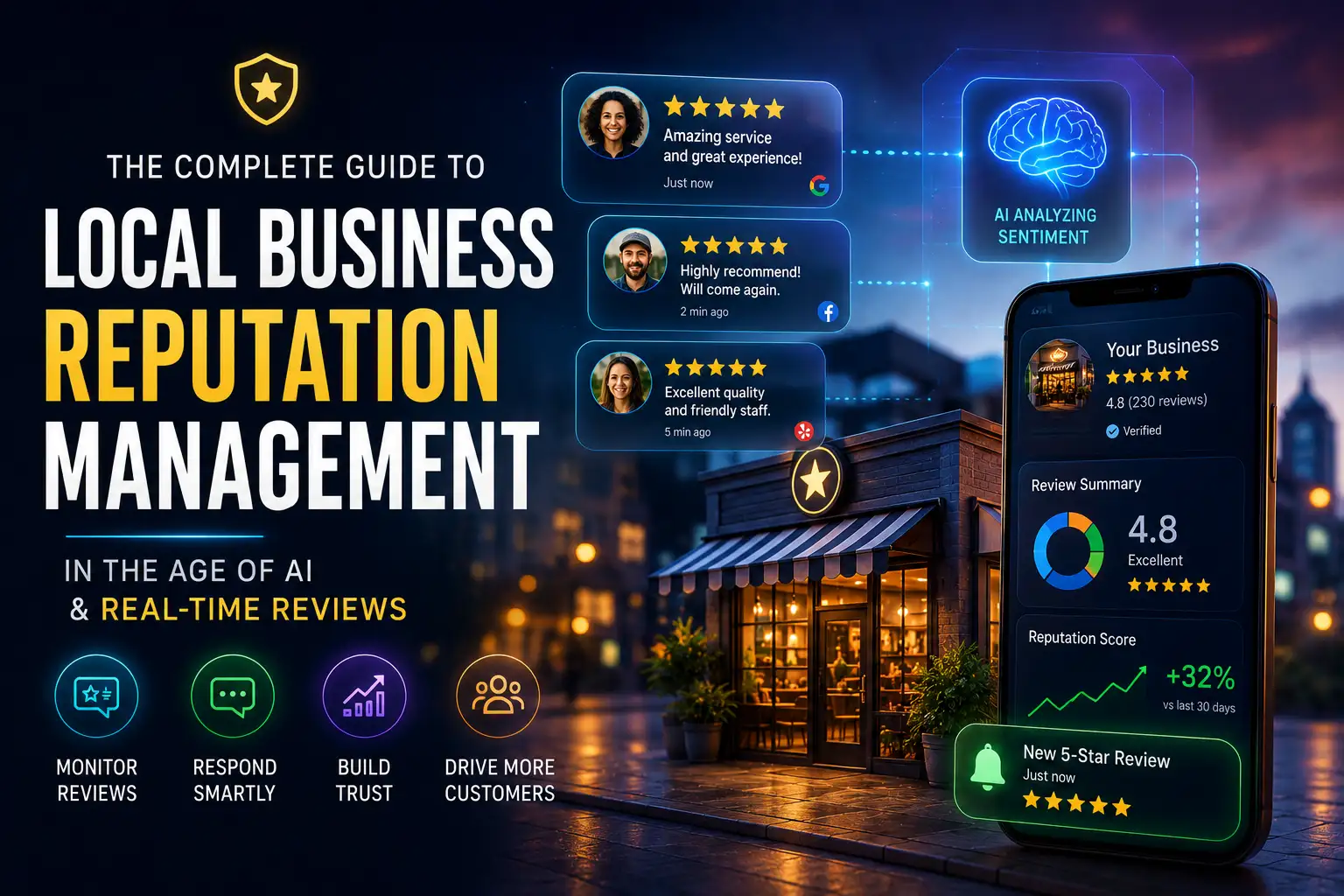
Reputation management has become more complex and more impactful than ever. This comprehensive guide covers every dimension of local business reputation in an AI-driven, always-on review environment.
In the age of AI-powered search and real-time review platforms, your business’s online reputation is no longer a secondary concern that you can address when convenient. It is a primary business asset one that influences your search rankings, shapes your AI recommendation profile, drives or suppresses your conversion rates, and either amplifies or undermines every other marketing investment you make. Comprehensive reputation management is non-negotiable for local businesses that want to compete effectively in 2026 and beyond.
Reputation management encompasses five interconnected dimensions. The first is proactive reputation building the systematic generation of authentic positive reviews that create a strong baseline of social proof. The second is responsive reputation management monitoring and responding to new reviews in a way that demonstrates accountability, care, and professionalism. The third is reputation recovery addressing and resolving negative reviews in a way that either satisfies the reviewer enough to update their assessment or demonstrates to prospective customers that you handle problems constructively. The fourth is reputation amplification strategically promoting your positive reputation through your listing profiles, website, and community communications. The fifth is reputation monitoring staying continuously aware of what’s being said about your business across every relevant platform.
AI systems have added a new dimension to reputation management: your review profile is now a training data source for AI recommendation models. AI systems don’t just count your reviews; they analyze their content, looking for consistent patterns in how customers describe your business. Businesses whose reviews consistently describe specific, accurate, positive outcomes become reliable recommendation targets for AI systems looking to answer queries about that specific type of service.
The most practical reputation management framework for a local business involves three weekly habits: reviewing and responding to any new reviews on all platforms (10 to 15 minutes), checking your review volume and rating trend in GBP Insights (5 minutes), and sending review requests to any customers served in the past week who haven’t yet reviewed (15 to 20 minutes). This 30 to 40 minute weekly practice, maintained consistently, builds a reputation asset that compounds in value over years.
Crisis reputation management responding to a sudden influx of negative reviews, a social media controversy, or a significant public complaint requires a different approach: immediate acknowledgment, off-platform resolution outreach, transparent communication, and a structured response to correct the underlying issue that generated the negative feedback. The businesses that recover most effectively from reputation crises are those that respond swiftly, communicate honestly, and demonstrate through subsequent actions that the issue has been genuinely addressed.
Frequently Asked Questions
Q: How many platforms should I monitor for reviews and reputation signals?
A: Monitor all platforms where your business has a presence and where customers in your category typically leave reviews. For most businesses, this means Google, Yelp, Facebook, your primary industry directory (Houzz, Healthgrades, Avvo, etc.), and City Connections Pro. Review monitoring tools like BrightLocal aggregate review notifications from multiple platforms into a single dashboard, making comprehensive monitoring practical.
Q: Can a business recover a 3-star rating and get back to 4-star territory?
A: Yes, though it requires sustained effort. The path is consistent generation of new, positive, detailed reviews over three to six months. Every new positive review dilutes the mathematical weight of older negative reviews. Combined with genuine service improvements and transparent communication about changes made in response to feedback, reputation recovery from a 3-star baseline to a 4+ star average is achievable for most businesses within six to twelve months.
Q: Should I hire a reputation management service or handle it in-house?
A: For most small to medium local businesses, in-house reputation management with the right tools (review monitoring software, a clear review request process) is adequate and more cost-effective than outsourced services. Consider professional reputation management services for businesses facing complex reputation crises, those in highly regulated industries with sensitive review content, or multi-location businesses whose review volume exceeds what in-house management can handle.